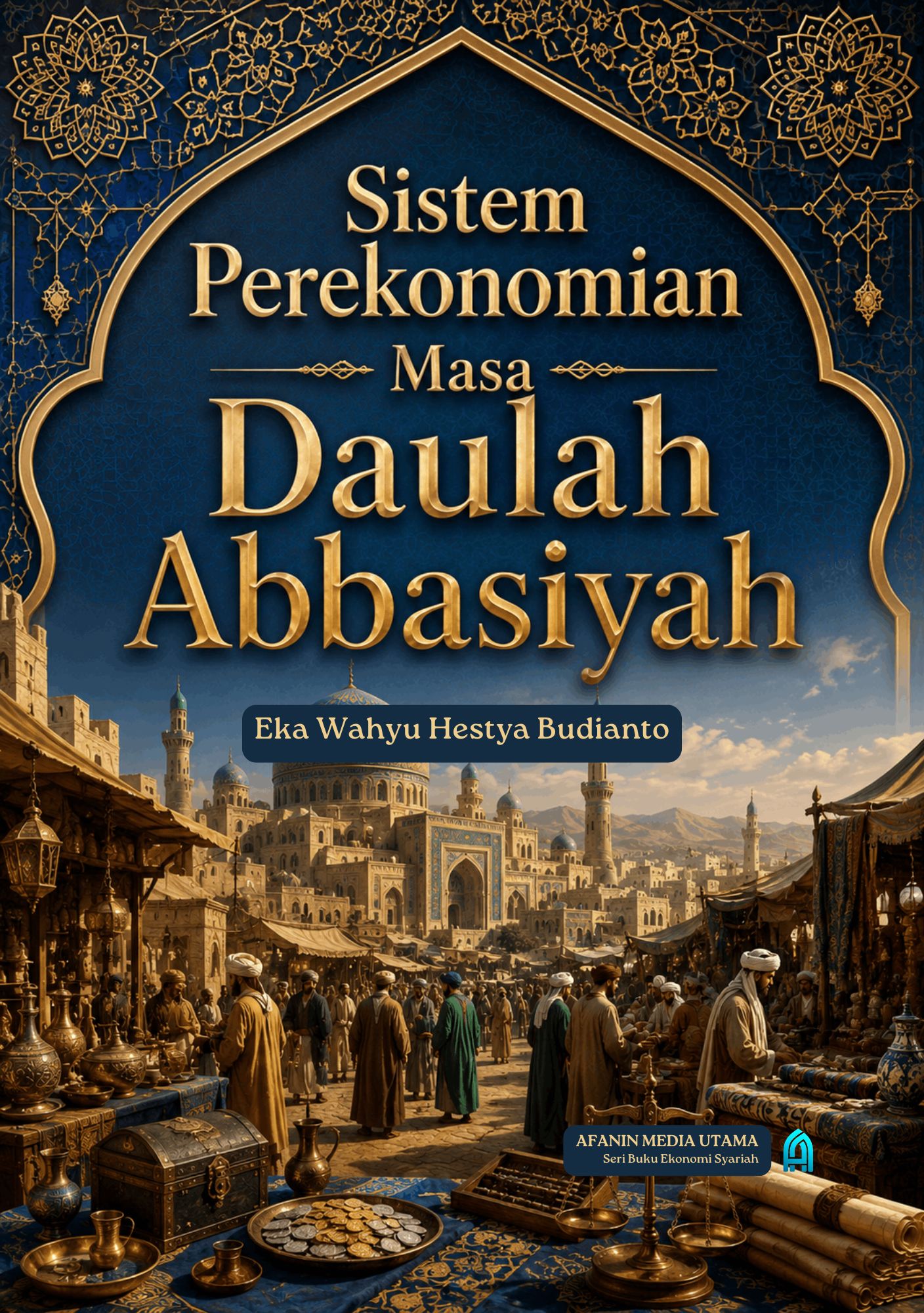
Sistem Perekonomian Masa Daulah Abbasiyah
Keywords:
Perekonomian, Daulah, AbbasiyahAbstract
Buku yang ada di tangan pembaca ini lahir dari sebuah keyakinan yang sangat dalam: bahwa peradaban Islam pernah mencapai puncak kemakmuran yang luar biasa, dan bahwa memahami bagaimana kemakmuran itu dibangun, dipertahankan, dan pada akhirnya mengalami kemunduran adalah salah satu tugas intelektual yang paling penting dan paling mendesak bagi umat Islam di era kontemporer. Daulah Abbasiyah yang bertakhta di Baghdad dari tahun 750 hingga 1258 Masehi merupakan salah satu puncak tertinggi yang pernah dicapai oleh peradaban manusia, dan di balik kemegahan yang sering diceritakan dalam legenda Seribu Satu Malam itu terdapat sebuah sistem ekonomi yang sangat canggih, sangat inovatif, dan sangat kaya yang selama ini belum mendapatkan perhatian akademis yang proporsional — terutama dalam literatur berbahasa Indonesia.
Selama lebih dari lima abad, kekhalifahan Abbasiyah membuktikan kepada dunia bahwa nilai-nilai Islam dan kemakmuran ekonomi bukan hanya kompatibel, tetapi saling memperkuat satu sama lain. Ketika Eropa masih terbenam dalam Abad Kegelapan, Baghdad telah menjadi kota metropolitan dengan lebih dari satu juta penduduk, pusat redistribusi komoditas dari seluruh penjuru dunia, dan rumah bagi ribuan ilmuwan, pedagang, pengrajin, serta bankir dari berbagai bangsa dan agama yang berdampingan dalam suatu ekosistem ekonomi yang hidup dan dinamis. Sistem irigasi Mesopotamia yang luar biasa canggih menopang produktivitas pertanian yang tidak tertandingi. Instrumen-instrumen keuangan Islam seperti mudharabah, musyarakah, hawala, dan suftajah memungkinkan perdagangan dalam skala global jauh sebelum Eropa mengenal konsep serupa. Baitul Hikmah yang didirikan oleh Khalifah Al-Ma’mun menjadi investasi terbesar dalam sejarah modal pengetahuan yang hasilnya mengalir tidak hanya kepada peradaban Islam, tetapi kepada seluruh umat manusia melalui jalur-jalur transfer ilmu yang akhirnya mencapai Eropa dan menjadi benih bagi Renaisans dan Revolusi Ilmiah.
Buku ini disusun sebagai upaya sintesis yang komprehensif dan sistematis. Pembahasan dimulai dari fondasi ideologis yang memberikan jiwa kepada seluruh sistem ekonomi Abbasiyah — prinsip-prinsip syariah tentang kehalalan berusaha, keadilan dalam bertransaksi, larangan riba dan gharar, serta kewajiban sosial atas kekayaan yang dimiliki. Dari fondasi tersebut, pembahasan mengalir kepada sistem fiskal dan keuangan negara yang menopang kemakmuran publik, sistem moneter dan perbankan yang memungkinkan transaksi dalam skala yang belum pernah ada sebelumnya, hingga sektor-sektor produktif yang menjadi tulang punggung perekonomian riil — pertanian yang revolusioner, industri dan kerajinan yang sangat inovatif, serta jaringan perdagangan internasional yang menghubungkan dunia dari Atlantik hingga Pasifik.
Pembahasan tentang struktur sosial dan pelaku ekonomi hadir untuk mengingatkan bahwa di balik angka-angka fiskal dan teori-teori ekonomi, terdapat manusia-manusia nyata — para petani yang mengolah tanah dengan ketekunan, para pedagang yang mengarungi samudra dengan keberanian, para ilmuwan yang berjaga di malam hari untuk menulis karya-karya yang menerangi peradaban, serta para perempuan yang kontribusinya sering kali tidak terlihat namun tidak kalah pentingnya. Kota-kota besar Abbasiyah — Baghdad, Basra, Nishapur, Bukhara, Fustat — dikaji sebagai laboratorium hidup tempat seluruh energi ekonomi peradaban bertemu dan bertransformasi menjadi kemakmuran yang nyata.
Tidak kalah penting adalah kejujuran intelektual dalam menghadapi kenyataan bahwa peradaban Abbasiyah juga mengalami kemunduran yang sangat menyedihkan. Korupsi yang menggerogoti sistem fiskal, ketidakstabilan politik yang menghalangi investasi jangka panjang, melemahnya investasi dalam infrastruktur dan ilmu pengetahuan, serta pada akhirnya kehancuran yang dibawa oleh invasi Mongol tahun 1258 M — semua ini dikaji dengan cermat bukan untuk meratapi masa lalu, melainkan untuk mengambil pelajaran yang sangat berharga tentang syarat-syarat yang harus dipenuhi agar kemakmuran dapat dibangun dan dipertahankan.
Buku ini juga menempatkan perekonomian Abbasiyah dalam konteks global, membandingkannya dengan perekonomian Byzantium, Kekaisaran Tang di Cina, kerajaan-kerajaan India, dan Eropa Carolingian. Perbandingan ini memperkuat sebuah kesimpulan yang sangat penting: bahwa pada masa puncaknya, perekonomian Abbasiyah tidak hanya unggul secara lokal, tetapi merupakan sistem ekonomi paling canggih dan paling produktif yang pernah ada di dunia pada zamannya, dengan warisan yang masih sangat terasa dalam sistem ekonomi global hingga hari ini.
References
Abu Dawud, Sulayman ibn Al-Ash’ath Al-Sijistani. Sunan Abi Dawud. Diedit oleh Muhammad Muhyi Al-Din ‘Abd Al-Hamid. 4 jilid. Beirut: Al-Maktabah Al-’Asriyyah, t.t.
Abu Ubayd, Al-Qasim ibn Sallam Al-Harawi. Kitab Al-Amwal. Diedit oleh Muhammad Khalil Harras. Kairo: Dar Al-Fikr, 1975.
Abu-Lughod, Janet L. Before European Hegemony: The World System A.D. 1250–1350. New York: Oxford University Press, 1989.
Abu Yusuf, Ya’qub ibn Ibrahim ibn Habib Al-Ansari. Kitab Al-Kharaj. Diedit oleh Muhammad Ibrahim Al-Banna. Kairo: Dar Al-Islah, 1981.
Adams, Robert McC. Land Behind Baghdad: A History of Settlement on the Diyala Plains. Chicago: University of Chicago Press, 1965.
Ahmad ibn Hanbal, Abu ‘Abd Allah Al-Shaybani. Musnad Al-Imam Ahmad ibn Hanbal. Diedit oleh Shu’ayb Al-Arna’ut, ‘Adil Murshid, et al. 50 jilid. Beirut: Mu’assasat Al-Risalah, 1995.
Ahmad ibn Majid Al-Sa’di Al-Najdi. Kitab Al-Fawa’id fi Usul ‘Ilm Al-Bahr wa Al-Qawa’id. Diedit oleh Ibrahim Khuri. Damaskus: Institut français de Damas, 1971.
Ahmed, Leila. Women and Gender in Islam: Historical Roots of a Modern Debate. New Haven: Yale University Press, 1992.
Al-Bayhaqi, Abu Bakr Ahmad ibn Al-Husayn ibn ‘Ali. Shu’ab Al-Iman. Diedit oleh Muhammad Al-Sa’id Basyuni Zaghlul. 7 jilid. Beirut: Dar Al-Kutub Al-’Ilmiyyah, 1410 H.
Al-Bukhari, Muhammad ibn Ismail ibn Ibrahim ibn Al-Mughirah. Shahih Al-Bukhari. Diedit oleh Muhammad Zuhair ibn Nasir Al-Nasir. 9 jilid. t.t.: Dar Tawq Al-Najah, 1422 H.
Al-Darimi, ‘Abd Allah ibn ‘Abd Al-Rahman ibn Al-Fadl. Sunan Al-Darimi. Diedit oleh Husayn Salim Asad Al-Darani. 4 jilid. Riyadh: Dar Al-Mughni, 2000.
Al-Dinawari, Abu Hanifah Ahmad ibn Dawud. Kitab Al-Nabat. Diedit oleh Muhammad Hamid Allah. Kairo: Institut français d’archéologie orientale, 1973.
Al-Fayumi, Muhammad Ibrahim. Al-Iqtishad Al-Islami: Al-Mudkhal wa Al-Manhaj. Kairo: Dar Al-Fikr Al-’Arabi, 1998.
Al-Ghazali, Abu Hamid Muhammad ibn Muhammad ibn Muhammad. Ihya’ ‘Ulum Al-Din. 4 jilid. Beirut: Dar Al-Ma’rifah, t.t.
Al-Hakim, Muhammad ibn ‘Abd Allah ibn Muhammad Al-Naysaburi. Al-Mustadrak ‘ala Al-Shahihayn. Diedit oleh Mustafa ‘Abd Al-Qadir ‘Ata. 4 jilid. Beirut: Dar Al-Kutub Al-’Ilmiyyah, 1990.
Al-Hassan, Ahmad Y. dan Donald R. Hill. Islamic Technology: An Illustrated History. Cambridge: Cambridge University Press, 1986.
Al-Istakhri, Ibrahim ibn Muhammad Al-Farisi Al-Karkhi. Masalik Al-Mamalik. Diedit oleh M.J. de Goeje. Leiden: E.J. Brill, 1870.
Al-Jahiz, ‘Amr ibn Bahr ibn Mahbub Al-Kinani Al-Basri. Rasa’il Al-Jahiz. Diedit oleh ‘Abd Al-Salam Muhammad Harun. 4 jilid. Kairo: Maktabah Al-Khanji, 1964.
Al-Jahshiyari, Muhammad ibn ‘Abdus. Kitab Al-Wuzara’ wa Al-Kuttab. Diedit oleh Mustafa Al-Saqqa, Ibrahim Al-Abyari, dan ‘Abd Al-Hafiz Shalabi. Kairo: Matba’ah Mustafa Al-Babi Al-Halabi, 1938.
Al-Marginani, ‘Ali ibn Abi Bakr ibn ‘Abd Al-Jalil Al-Farghani. Al-Hidayah fi Sharh Bidayat Al-Mubtadi. Diedit oleh Talal Yusuf. 4 jilid. Beirut: Dar Ihya’ Al-Turath Al-’Arabi, t.t.
Al-Mas’udi, Abu Al-Hasan ‘Ali ibn Al-Husayn ibn ‘Ali. Muruj Al-Dhahab wa Ma’adin Al-Jawhar. Diedit oleh Charles Pellat. 7 jilid. Beirut: Al-Jami’ah Al-Lubnaniyyah, 1966–1979.
Al-Mawardi, Abu Al-Hasan ‘Ali ibn Muhammad ibn Habib Al-Basri. Al-Ahkam Al-Sultaniyyah wa Al-Wilayat Al-Diniyyah. Diedit oleh Ahmad Mubarak Al-Baghdadi. Kuwait: Dar Ibn Qutaibah, 1989.
Al-Muqaddasi, Muhammad ibn Ahmad ibn Abi Bakr Al-Banna’ Al-Shams Al-Din. Ahsan Al-Taqasim fi Ma’rifat Al-Aqalim. Diedit oleh M.J. de Goeje. Leiden: E.J. Brill, 1877. Cetak ulang, 1967.
Al-Nadim, Muhammad ibn Ishaq ibn Muhammad ibn Ishaq Al-Warraq Al-Baghdadi. Al-Fihrist. Diedit oleh Rida Tajaddud. Tehran: Marvi Offset Printing, 1971.
Al-Nadwi, Muhammad Akram. Al-Muhaddithat: The Women Scholars in Islam. London: Interface Publications, 2007.
Al-Nasa’i, Ahmad ibn Shu’ayb ibn ‘Ali Al-Khurasani. Sunan Al-Nasa’i Al-Kubra. Diedit oleh ‘Abd Al-Ghaffar Sulayman Al-Bandari dan Sayyid Kisrawi Hasan. 6 jilid. Beirut: Dar Al-Kutub Al-’Ilmiyyah, 1991.
Al-Qaradawi, Yusuf. Dawr Al-Qiyam wa Al-Akhlaq fi Al-Iqtishad Al-Islami. Kairo: Maktabah Wahbah, 1995.
Al-Shaybani, Muhammad ibn Al-Hasan ibn Farqad. Al-Jami’ Al-Kabir. Diedit oleh Abu Al-Wafa’ Al-Afghani. Hyderabad: Lajnat Ihya’ Al-Ma’arif Al-Nu’maniyyah, 1936.
Al-Shayzari, ‘Abd Al-Rahman ibn Nasr ibn ‘Abd Allah. Nihayat Al-Rutbah fi Talab Al-Hisbah. Diedit oleh Al-Sayyid Al-Baz Al-’Arini. Beirut: Dar Al-Thaqafah, 1981.
Al-Tabari, Muhammad ibn Jarir ibn Yazid ibn Kathir ibn Ghalib Al-Amuli. Tarikh Al-Rusul wa Al-Muluk. Diedit oleh M.J. de Goeje et al. 15 jilid. Leiden: E.J. Brill, 1879–1901.
Al-Tirmidzi, Muhammad ibn ‘Isa ibn Sawrah ibn Musa Al-Sulami. Sunan Al-Tirmidzi. Diedit oleh Ahmad Muhammad Shakir, Muhammad Fu’ad ‘Abd Al-Baqi, dan Ibrahim ‘Atwah ‘Awad. 5 jilid. Kairo: Maktabah Mustafa Al-Babi Al-Halabi, 1975.
Al-Ya’qubi, Ahmad ibn Abi Ya’qub ibn Ja’far ibn Wahb ibn Wadih. Kitab Al-Buldan. Diedit oleh M.J. de Goeje. Leiden: E.J. Brill, 1892.
Allsen, Thomas T. Culture and Conquest in Mongol Eurasia. Cambridge: Cambridge University Press, 2001.
Ashtor, Eliyahu. A Social and Economic History of the Near East in the Middle Ages. London: Collins, 1976.
Ashtor, Eliyahu. Histoire des prix et des salaires dans l’Orient médiéval. Paris: École pratique des hautes études, 1969.
Ayalon, David. “The Mamluks of the Seljuks: Islam’s Military Might at the Crossroads.” Journal of the Royal Asiatic Society 6, no. 3 (1996): 305–333.
Bank Indonesia. Peta Jalan Pengembangan Keuangan Syariah Indonesia 2023–2025. Jakarta: Bank Indonesia, 2023.
Bates, Michael L. “History of Islamic Coinage.” Dalam The Oxford Encyclopedia of the Modern Islamic World, Vol. 1. New York: Oxford University Press, 1995.
Bates, Michael L. “Islamic Numismatics.” Middle East Studies Association Bulletin 12, no. 2 (1978): 1–16; 13, no. 1 (1979): 3–21.
Beattie, May H. Carpets of Central Persia. Sheffield: World of Islam Festival Trust, 1976.
Bianquis, Thierry. “Autonomous Egypt from Ibn Tulun to Kafur, 868–969.” Dalam The Cambridge History of Egypt, Vol. 1. Diedit oleh Carl F. Petry. Cambridge: Cambridge University Press, 1998.
Bloom, Jonathan M. Paper before Print: The History and Impact of Paper in the Islamic World. New Haven: Yale University Press, 2001.
Bolens, Lucie. Agronomes andalous du moyen-âge. Geneva: Droz, 1981.
Bosworth, Clifford Edmund. The New Islamic Dynasties: A Chronological and Genealogical Manual. Edinburgh: Edinburgh University Press, 1996.
Bosworth, Clifford Edmund. “Al-Rayy.” Dalam Encyclopaedia of Islam, edisi ke-2. Vol. 8. Leiden: E.J. Brill, 1995.
Bosworth, Clifford Edmund. “Isfahan.” Dalam Encyclopaedia of Islam, edisi ke-2. Vol. 4. Leiden: E.J. Brill, 1978.
Bowen, Harold. “Buwayhids or Buwayhides.” Dalam Encyclopaedia of Islam, edisi ke-2. Vol. 1. Leiden: E.J. Brill, 1960.
Buckley, R.P. “The Muhtasib.” Arabica 39, no. 1 (1992): 59–117.
Bulliet, Richard. Cotton, Climate, and Camels in Early Islamic Iran: A Moment in World History. New York: Columbia University Press, 2009.
Bulliet, Richard. The Camel and the Wheel. Cambridge, MA: Harvard University Press, 1975.
Bulliet, Richard. The Patricians of Nishapur: A Study in Medieval Islamic Social History. Cambridge, MA: Harvard University Press, 1972.
Burnett, Charles. “The Translating Activity in Medieval Spain.” Dalam The Legacy of Muslim Spain. Diedit oleh Salma Khadra Jayyusi. Leiden: E.J. Brill, 1992.
Cahen, Claude. “Fiscalité, propriété, antagonismes sociaux en Haute-Mésopotamie au temps des premiers ‘Abbāsides.” Arabica 1, no. 2 (1954): 136–152.
Cahen, Claude. “Hisba.” Dalam Encyclopaedia of Islam, edisi ke-2. Vol. 3. Leiden: E.J. Brill, 1971.
Cahen, Claude. “L’évolution de l’iqta du IXe au XIIIe siècle.” Annales: Economies, Sociétés, Civilisations 8 (1953): 25–52.
Chapra, M. Umer. Islam and the Economic Challenge. Leicester: The Islamic Foundation, 1992.
Chapra, M. Umer. The Future of Economics: An Islamic Perspective. Leicester: The Islamic Foundation, 2000.
Chapra, M. Umer. Towards a Just Monetary System. Leicester: The Islamic Foundation, 1985.
Choudhury, M.A. Islamic Economic Co-operation. London: Macmillan, 1989.
Cizakca, Murat. A History of Philanthropic Foundations: The Islamic World from the Seventh Century to the Present. Istanbul: Bogazici University Press, 2000.
Cizakca, Murat. Islamic Capitalism and Finance: Origins, Evolution and the Future. Cheltenham: Edward Elgar, 2011.
Clarence-Smith, William Gervase. Islam and the Abolition of Slavery. London: Hurst & Company, 2006.
Cohen, Mark R. Under Crescent and Cross: The Jews in the Middle Ages. Princeton: Princeton University Press, 1994.
Constable, Olivia Remie. Housing the Stranger in the Mediterranean World: Lodging, Trade, and Travel in Late Antiquity and the Middle Ages. Cambridge: Cambridge University Press, 2003.
Constable, Olivia Remie. Trade and Traders in Muslim Spain: The Commercial Realignment of the Iberian Peninsula, 900–1500. Cambridge: Cambridge University Press, 1994.
Cooperson, Michael. Al-Ma’mun. Oxford: Oneworld Publications, 2005.
Creswell, K.A.C. Early Muslim Architecture. 2 vol. Oxford: Clarendon Press, 1932–1940.
Crone, Patricia. Meccan Trade and the Rise of Islam. Princeton: Princeton University Press, 1987.
Crone, Patricia. Slaves on Horses: The Evolution of the Islamic Polity. Cambridge: Cambridge University Press, 1980.
Decker, Michael. “Plants and Progress: Rethinking the Islamic Agricultural Revolution.” Journal of World History 20, no. 2 (2009): 187–206.
Duri, A.A. The Rise of Historical Writing Among the Arabs. Diterjemahkan oleh Lawrence I. Conrad. Princeton: Princeton University Press, 1983.
Ehrenkreutz, Andrew S. “Monetary Aspects of Medieval Near Eastern Economic History.” Dalam Studies in the Economic History of the Middle East. Diedit oleh M.A. Cook. London: Oxford University Press, 1970.
Ehrenkreutz, Andrew S. “Studies in the Monetary History of the Near East in the Middle Ages.” Journal of the Economic and Social History of the Orient 2, no. 2 (1959): 128–161.
El-Gamal, Mahmoud A. Islamic Finance: Law, Economics, and Practice. Cambridge: Cambridge University Press, 2006.
El-Hibri, Tayeb. Reinterpreting Islamic Historiography: Harun al-Rashid and the Narrative of the ‘Abbasid Caliphate. Cambridge: Cambridge University Press, 1999.
Elisséeff, Nikita. “Dimashk.” Dalam Encyclopaedia of Islam, edisi ke-2. Vol. 2. Leiden: E.J. Brill, 1965.
English, Paul Ward. City and Village in Iran: Settlement and Economy in the Kirman Basin. Madison: University of Wisconsin Press, 1966.
Fakhry, Majid. A History of Islamic Philosophy. Edisi ke-3. New York: Columbia University Press, 2004.
Fischel, Walter J. Jews in the Economic and Political Life of Mediaeval Islam. London: Royal Asiatic Society, 1937.
Freedman, Paul. Out of the East: Spices and the Medieval Imagination. New Haven: Yale University Press, 2008.
Frye, Richard N. The Golden Age of Persia: The Arabs in the East. London: Weidenfeld and Nicolson, 1975.
Frye, Richard N. The Heritage of Persia. London: Weidenfeld and Nicolson, 1962.
Frye, Richard N. “The Samanids.” Dalam The Cambridge History of Iran, Vol. 4. Diedit oleh R.N. Frye. Cambridge: Cambridge University Press, 1975.
Gibb, J.C.L. “Halab.” Dalam Encyclopaedia of Islam, edisi ke-2. Vol. 3. Leiden: E.J. Brill, 1971.
Goitein, S.D. A Mediterranean Society: The Jewish Communities of the Arab World as Portrayed in the Documents of the Cairo Geniza. 6 vol. Berkeley: University of California Press, 1967–1993.
Greif, Avner. Institutions and the Path to the Modern Economy: Lessons from Medieval Trade. Cambridge: Cambridge University Press, 2006.
Grube, Ernst. Islamic Pottery of the Eighth to Fifteenth Century in the Keir Collection. London: Faber and Faber, 1976.
Gutas, Dmitri. Greek Thought, Arabic Culture: The Graeco-Arabic Translation Movement in Baghdad and Early ‘Abbasid Society (2nd–4th/8th–10th Centuries). London: Routledge, 1998.
Hallaq, Wael B. A History of Islamic Legal Theories: An Introduction to Sunni Usul al-Fiqh. Cambridge: Cambridge University Press, 1997.
Haque, Ziaul. Landlord and Peasant in Early Islam: A Study of the Agrarian System of the Early Abbasid Caliphate. Islamabad: Islamic Research Institute, 1977.
Hartmann, Angelika. An-Nasir li-Din Allah (1180–1225): Politik, Religion, Kultur in der späten Abbasidenzeit. Berlin: Walter de Gruyter, 1975.
Hartwell, Robert. “Markets, Technology, and the Structure of Enterprise in the Development of the Eleventh-Century Chinese Iron and Steel Industry.” Journal of Economic History 26, no. 1 (1966): 29–58.
Henderson, Julian. The Science and Archaeology of Materials: An Investigation of Inorganic Materials. London: Routledge, 2000.
Herrin, Judith. Byzantium: The Surprising Life of a Medieval Empire. Princeton: Princeton University Press, 2007.
Herzfeld, Ernst. Geschichte der Stadt Samarra. Hamburg: Eckardt & Messtorff, 1948.
Hill, Donald R. A History of Engineering in Classical and Medieval Times. London: Croom Helm, 1984.
Hillenbrand, Carole. The Crusades: Islamic Perspectives. Edinburgh: Edinburgh University Press, 1999.
Hillenbrand, Robert. Islamic Architecture: Form, Function and Meaning. Edinburgh: Edinburgh University Press, 1994.
Hitti, Philip K. History of the Arabs: From the Earliest Times to the Present. Edisi ke-10. London: Macmillan Publishers, 1970.
Hocquet, Jean-Claude. Le sel et la fortune de Venise. 2 vol. Villeneuve-d’Ascq: Presses universitaires de Lille, 1978.
Hodges, Richard dan David Whitehouse. Mohammed, Charlemagne and the Origins of Europe: Archaeology and the Pirenne Thesis. London: Duckworth, 1983.
Hodgson, Marshall G.S. The Venture of Islam: Conscience and History in a World Civilization. 3 vol. Chicago: University of Chicago Press, 1974.
Hoexter, Miriam. “Waqf Studies in the Twentieth Century: The State of the Art.” Journal of the Economic and Social History of the Orient 41, no. 4 (1998): 474–495.
Horton, Mark dan John Middleton. The Swahili: The Social Landscape of a Mercantile Society. Oxford: Blackwell, 2000.
Hourani, George F. Arab Seafaring in the Indian Ocean in Ancient and Early Medieval Times. Edisi revisi oleh John Carswell. Princeton: Princeton University Press, 1995.
Hyland, Ann. The Medieval Warhorse: From Byzantium to the Crusades. Stroud: Alan Sutton, 1994.
Ibn Al-’Awwam, Yahya ibn Muhammad ibn Ahmad Al-Ishbili. Kitab Al-Filaha. Diedit dan diterjemahkan oleh J.A. Banqueri. Madrid, 1802. Cetak ulang, Seville: Arab al-Andalus, 2005.
Ibn Al-Atsir, ‘Izz Al-Din Abu Al-Hasan ‘Ali ibn Muhammad Al-Shaybani Al-Jazari. Al-Kamil fi Al-Tarikh. Diedit oleh C.J. Tornberg. 13 jilid. Leiden: E.J. Brill, 1851–1876. Cetak ulang, Beirut: Dar Sadir, 1979.
Ibn Al-Baitar, Diya’ Al-Din Abu Muhammad ‘Abd Allah ibn Ahmad Al-Malaqi. Al-Jami’ li Mufradat Al-Adwiyah wa Al-Aghdhiyah. Diedit oleh Ibrahim Shams Al-Din. Beirut: Dar Al-Kutub Al-’Ilmiyyah, 2010.
Ibn Al-Razzaz Al-Jazari, Badi’ Al-Zaman Isma’il ibn Al-Razzaz. Kitab fi Ma’rifat Al-Hiyal Al-Handasiyyah. Diterjemahkan oleh Donald R. Hill sebagai The Book of Knowledge of Ingenious Mechanical Devices. Dordrecht: D. Reidel, 1974.
Ibn Battutah, Muhammad ibn ‘Abd Allah ibn Muhammad Al-Lawati Al-Tanji. Rihla Ibn Battutah: Tuhfat Al-Nuzzar fi Ghara’ib Al-Amsar wa ‘Aja’ib Al-Asfar. Diedit oleh ‘Abd Al-Hadi Al-Tazi. 4 jilid. Rabat: Akademiyat Al-Mamlakah Al-Maghribiyyah, 1417 H.
Ibn Hawqal, Muhammad Abu Al-Qasim Al-Nisibi. Kitab Surat Al-Ardh. Diedit oleh J.H. Kramers. Leiden: E.J. Brill, 1938.
Ibn Khaldun, Wali Al-Din ‘Abd Al-Rahman ibn Muhammad ibn Muhammad. Muqaddimah Ibn Khaldun. Diedit oleh ‘Abd Al-Salam Al-Shaddadi. 3 jilid. Casablanca: Bayt Al-Funun wa Al-’Ulum wa Al-Adab, 2005.
Ibn Khurdadhbih, ‘Ubayd Allah ibn ‘Abd Allah. Kitab Al-Masalik wa Al-Mamalik. Diedit oleh M.J. de Goeje. Leiden: E.J. Brill, 1889.
Ibn Majah, Muhammad ibn Yazid Al-Qazwini. Sunan Ibn Majah. Diedit oleh Muhammad Fu’ad ‘Abd Al-Baqi. 2 jilid. Kairo: Dar Ihya’ Al-Kutub Al-’Arabiyyah, t.t.
Ibn Qudamah Al-Maqdisi, Muwaffaq Al-Din Abu Muhammad ‘Abd Allah ibn Ahmad. Al-Mughni. Diedit oleh ‘Abd Allah ibn ‘Abd Al-Muhsin Al-Turki dan ‘Abd Al-Fattah Muhammad Al-Hulw. 15 jilid. Riyadh: Dar ‘Alam Al-Kutub, 1997.
Ibn Sina, Abu ‘Ali Al-Husayn ibn ‘Abd Allah ibn Al-Hasan ibn ‘Ali. Al-Qanun fi Al-Tibb. 5 jilid. Beirut: Dar Sadir, 2005.
Ibn Wahshiyya, Abu Bakr Ahmad ibn ‘Ali ibn Musa Al-Nabati Al-Kasdani. Al-Filaha Al-Nabatiyyah. Diedit oleh Toufic Fahd. Damaskus: Institut français de Damas, 1993–1995.
Jalil, Abol Hassan, Aidit Ghazali, dan Syed Omar Syed Agil. “A Historical Survey of Accounting Concepts in Quran and Sunnah.” IIUM Journal of Economics and Management 16, no. 1 (2008): 27–50.
Johansen, Baber. The Islamic Law on Land Tax and Rent: The Peasants’ Loss of Property Rights as Interpreted in the Hanafite Legal Literature of the Mamluk and Ottoman Periods. London: Croom Helm, 1988.
Jost, Patrick dan Harjit Singh Sandhu. “The Hawala Alternative Remittance System and Its Role in Money Laundering.” Interpol General Secretariat, Lyon (2000): 1–30.
Juynboll, G.H.A. “The Qurra’ in Early Islamic History.” Journal of the Economic and Social History of the Orient 16, no. 2/3 (1973): 113–129.
Kahf, Monzer. “Zakah: Performance and Role in the Economy.” Dalam Encyclopedia of Islamic Banking and Finance. London: Institute of Islamic Banking and Insurance, 1995.
Kennedy, Hugh. The Court of the Caliphs: The Rise and Fall of Islam’s Greatest Dynasty. London: Weidenfeld and Nicolson, 2004.
Kennedy, Hugh. The Early Abbasid Caliphate: A Political History. London: Croom Helm, 1981.
Kennedy, Hugh. The Prophet and the Age of the Caliphates: The Islamic Near East from the Sixth to the Eleventh Century. Edisi ke-2. London: Pearson Longman, 2004.
Kementerian Agama RI. Al-Qur’an dan Terjemahannya. Jakarta: Kementerian Agama RI, 2019.
Kraemer, Joel L. Humanism in the Renaissance of Islam: The Cultural Revival during the Buyid Age. Leiden: E.J. Brill, 1986.
Kuhn, Dieter. “Silk Technology in the Sung Period (960–1278).” T’oung Pao 67, no. 4/5 (1981): 265–305.
Labib, Subhi Y. “Capitalism in Medieval Islam.” The Journal of Economic History 29, no. 1 (1969): 79–96.
Laiou, Angeliki E. dan Cecile Morrison. The Byzantine Economy. Cambridge: Cambridge University Press, 2007.
Lambton, Ann K.S. Landlord and Peasant in Persia: A Study of Land Tenure and Land Revenue Administration. London: Oxford University Press, 1953.
Lambton, Ann K.S. “The Internal Structure of the Saljuq Empire.” Dalam The Cambridge History of Iran, Vol. 5. Diedit oleh J.A. Boyle. Cambridge: Cambridge University Press, 1968.
Lapidus, Ira M. A History of Islamic Societies. Edisi ke-2. Cambridge: Cambridge University Press, 2002.
Lapidus, Ira M. Muslim Cities in the Later Middle Ages. Cambridge, MA: Harvard University Press, 1967.
Lassner, Jacob. The Shaping of ‘Abbasid Rule. Princeton: Princeton University Press, 1980.
Lassner, Jacob. The Topography of Baghdad in the Early Middle Ages: Text and Studies. Detroit: Wayne State University Press, 1970.
Le Strange, Guy. Baghdad During the Abbasid Caliphate: From Contemporary Arabic and Persian Sources. Oxford: Oxford University Press, 1900. Cetak ulang, London: Curzon Press, 1972.
Levtzion, Nehemia dan J.F.P. Hopkins, eds. Corpus of Early Arabic Sources for West African History. Cambridge: Cambridge University Press, 1981.
Lewis, Bernard. Race and Slavery in the Middle East: An Historical Enquiry. New York: Oxford University Press, 1990.
Liu, Xinru. The Silk Road in World History. New York: Oxford University Press, 2010.
Maddison, Angus. The World Economy: Historical Statistics. Paris: OECD Development Centre, 2003.
Mahdi, Muhsin. Ibn Khaldun’s Philosophy of History: A Study in the Philosophic Foundation of the Science of Culture. London: George Allen and Unwin, 1957.
Makdisi, George. The Rise of Colleges: Institutions of Learning in Islam and the West. Edinburgh: Edinburgh University Press, 1981.
Mannan, Muhammad Abdul. Islamic Economics: Theory and Practice: A Comparative Study. Cambridge: Hodder and Stoughton, 1986.
McCormick, Michael. Origins of the European Economy: Communications and Commerce, A.D. 300–900. Cambridge: Cambridge University Press, 2001.
Mez, Adam. The Renaissance of Islam. Diterjemahkan oleh S. Khuda Bukhsh dan D.S. Margoliouth. London: Luzac & Co., 1937.
Minorsky, V. “Marw.” Dalam Encyclopaedia of Islam, edisi ke-2. Vol. 6. Leiden: E.J. Brill, 1991.
Mintz, Sidney. Sweetness and Power: The Place of Sugar in Modern History. New York: Viking, 1985.
Muslim ibn Al-Hajjaj Al-Qushairi Al-Naysaburi. Shahih Muslim. Diedit oleh Muhammad Fu’ad ‘Abd Al-Baqi. 5 jilid. Beirut: Dar Ihya’ Al-Turath Al-’Arabi, t.t.
Naqvi, Syed Nawab Haider. Ethics and Economics: An Islamic Synthesis. Leicester: The Islamic Foundation, 1981.
Nasr, Seyyed Hossein. Islamic Science: An Illustrated Study. London: World of Islam Festival Publishing Company, 1976.
Nasr, Seyyed Hossein. Science and Civilization in Islam. Cambridge, MA: Harvard University Press, 1968.
Newman, William R. Promethean Ambitions: Alchemy and the Quest to Perfect Nature. Chicago: University of Chicago Press, 2004.
Nicolle, David. Arms and Armour of the Crusading Era, 1050–1350: Islam, Eastern Europe and Asia. 2 vol. White Plains, NY: Kraus International Publications, 1988.
Nizam Al-Mulk, Hasan ibn ‘Ali ibn Ishaq Al-Tusi. Siyasatnamah. Diedit oleh Hubert Darke. Tehran: Bungah-i Tarjumah wa Nashr-i Kitab, 1347 H.Sh.
Noonan, Thomas S. “Monetary Circulation in Early Medieval Rus’: A Study of Dirhams Hoards from before c. 900–c. 1150.” Russian History 7, no. 3 (1980): 294–311.
Noonan, Thomas S. “Why the Vikings First Came to Russia.” Jahrbücher für Geschichte Osteuropas 34, no. 3 (1986): 321–348.
Northedge, Alastair. The Historical Topography of Samarra. London: British School of Archaeology in Iraq, 2005.
O’Connor, J.J. dan E.F. Robertson. “Muhammad ibn Musa Al-Khwarizmi.” MacTutor History of Mathematics Archive. St Andrews: University of St Andrews, 1999.
Pedersen, Johannes. The Arabic Book. Diterjemahkan oleh Geoffrey French. Princeton: Princeton University Press, 1984.
Pellat, Charles. Le milieu basrien et la formation de Gahiz. Paris: Maisonneuve, 1953.
Popovic, Alexandre. The Revolt of African Slaves in Iraq in the 3rd/9th Century. Diterjemahkan oleh Leon King. Princeton: Markus Wiener Publishers, 1999.
Potts, Daniel. “The Barmakids and Central Asian Administration.” Dalam Encyclopaedia Iranica, Vol. 3. London: Routledge & Kegan Paul, 1989.
Reid, Anthony. Southeast Asia in the Age of Commerce, 1450–1680. 2 vol. New Haven: Yale University Press, 1988–1993.
Robinson, Chase F. Abd al-Malik. Oxford: Oneworld Publications, 2005.
Rodinson, Maxime. Islam and Capitalism. Diterjemahkan oleh Brian Pearce. London: Penguin Books, 1974.
Sadan, Josef. “Al-Dinawari.” Dalam Encyclopaedia of Islam, edisi ke-2. Vol. 2. Leiden: E.J. Brill, 1965.
Saleh, Nabil. Unlawful Gain and Legitimate Profit in Islamic Law: Riba, Gharar and Islamic Banking. Cambridge: Cambridge University Press, 1986.
Saliba, George. Islamic Science and the Making of the European Renaissance. Cambridge, MA: MIT Press, 2007.
Sanders, Paula. “The Fatimid State, 969–1171.” Dalam The Cambridge History of Egypt, Vol. 1. Diedit oleh Carl F. Petry. Cambridge: Cambridge University Press, 1998.
Sarre, Friedrich. Die Keramik von Samarra. Berlin: Reimer, 1925.
Saunders, J.J. The History of the Mongol Conquests. London: Routledge & Kegan Paul, 1971.
Schacht, Joseph. An Introduction to Islamic Law. Oxford: Clarendon Press, 1964.
Schafer, Edward H. The Golden Peaches of Samarkand: A Study of T’ang Exotics. Berkeley: University of California Press, 1963.
Schorsch, Jonathan. Jews and Blacks in the Early Modern World. Cambridge: Cambridge University Press, 2004.
Serjeant, R.B. Islamic Textiles: Material for a History up to the Mongol Conquest. Beirut: Librairie du Liban, 1972.
Shepherd, Dorothy G. “Medieval Persian Silks in Fact and Fancy.” Bulletin de liaison du Centre international d’étude des textiles anciens 39–40 (1974): 5–39.
Siddiqi, Muhammad Nejatullah. Role of the State in the Economy: An Islamic Perspective. Leicester: The Islamic Foundation, 1996.
Silverstein, Adam J. Postal Systems in the Pre-Modern Islamic World. Cambridge: Cambridge University Press, 2007.
Sonbol, Amira El Azhary, ed. Women, the Family, and Divorce Laws in Islamic History. Syracuse: Syracuse University Press, 1996.
Sourdel, Dominique. Le vizirat ‘abbâside de 749 à 936. 2 vol. Damaskus: Institut français de Damas, 1959–1960.
Spufford, Peter. Money and Its Use in Medieval Europe. Cambridge: Cambridge University Press, 1988.
Stern, S.M. “The Constitution of the Islamic City.” Dalam The Islamic City: A Colloquium. Diedit oleh A.H. Hourani dan S.M. Stern. Oxford: Cassirer, 1970.
Sulayman Al-Tajir dan Abu Zayd Al-Sirafi. Akhbar Al-Sin wa Al-Hind. Diedit dan diterjemahkan oleh Jean Sauvaget. Paris: Société d’édition Les belles lettres, 1948.
Treadwell, Luke. Buyid Coinage: A Die Corpus (322–445 A.H.). Oxford: Ashmolean Museum, 2001.
Twitchett, Denis, ed. The Cambridge History of China, Vol. 3: Sui and T’ang China, 589–906. Cambridge: Cambridge University Press, 1979.
Tyan, Emile. Histoire de l’organisation judiciaire en pays d’Islam. Leiden: E.J. Brill, 1960.
Udovitch, Abraham L. Partnership and Profit in Medieval Islam. Princeton: Princeton University Press, 1970.
Ullmann, Manfred. Islamic Medicine. Edinburgh: Edinburgh University Press, 1978.
Usmani, Muhammad Taqi. An Introduction to Islamic Finance. The Hague: Kluwer Law International, 2002.
Volov, Lisa. “Plaited Kufic on Samanid Epigraphic Pottery.” Ars Orientalis 8 (1966): 107–133.
Vogel, Frank E. dan Samuel L. Hayes III. Islamic Law and Finance: Religion, Risk, and Return. The Hague: Kluwer Law International, 1998.
Waines, David. “The Third Century Internal Crisis of the Abbasids.” Journal of the Economic and Social History of the Orient 20, no. 3 (1977): 282–306.
Walker, John. A Catalogue of the Arab-Byzantine and Post-Reform Umaiyad Coins. London: British Museum, 1956.
Ward, Rachel. Islamic Metalwork. London: British Museum Press, 1993.
Watson, Andrew M. Agricultural Innovation in the Early Islamic World: The Diffusion of Crops and Farming Techniques, 700–1100. Cambridge: Cambridge University Press, 1983.
Watson, Oliver. Ceramics from Islamic Lands. London: Thames and Hudson, 2004.
Wheatley, Paul. The Places Where Men Pray Together: Cities in Islamic Lands, Seventh through the Tenth Centuries. Chicago: University of Chicago Press, 2001.
Whitehouse, David. Siraf III: The Congregational Mosque. London: British Institute of Persian Studies, 1980.
Whitehouse, David dan Andrew Williamson. “Sasanian Maritime Trade.” Iran 11 (1973): 29–49.
Williams, Gareth, Peter Pentz, dan Matthias Wemhoff, eds. Money and Its Uses in the Medieval World. Cambridge: Cambridge University Press, 2018.
Wilson, Rodney. Economics, Ethics and Religion: Jewish, Christian and Muslim Economic Thought. New York: New York University Press, 1997.
Wolters, O.W. Early Indonesian Commerce: A Study of the Origins of Srivijaya. Ithaca: Cornell University Press, 1967.
Yahya ibn Adam Al-Qarashi. Kitab Al-Kharaj. Diedit dan diterjemahkan oleh A. Ben Shemesh. Leiden: E.J. Brill, 1958.
Yang, Lien-sheng. Money and Credit in China: A Short History. Cambridge, MA: Harvard University Press, 1952.
Yaqut Al-Hamawi Al-Rumi, Shihab Al-Din Abu ‘Abd Allah. Mu’jam Al-Buldan. 5 jilid. Beirut: Dar Sadir, 1977.